





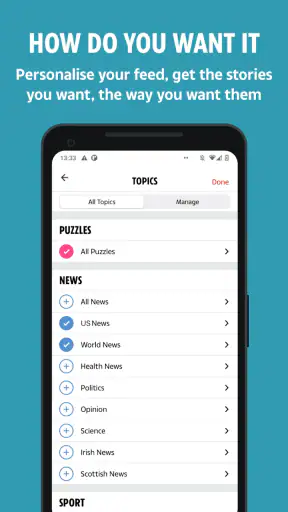



I started using The Sun Mobile - Daily News as the sort of app I would keep on a phone for quick checks rather than long reading sessions. It belongs to the News & Magazines category and brings together news, sport, television coverage and celebrity stories in one place. That mix makes sense for a shared household device: one person can check the morning headlines, another can look for match coverage, and someone else can browse entertainment news without switching between several specialist apps.
My overall impression is positive, but it depends heavily on what you expect from a news app. I found it most useful when I wanted a fast overview of the stories currently getting attention. It is less convincing as the only source for careful, deeply reported coverage across every subject. The app is free to download, although some individual items cost between $1.99 and $12.99, so I would treat the free entry point and the optional paid content as two separate parts of the experience.
How it works on a shared household phone
A realistic use case is a phone left in the kitchen or passed around during the day. In the morning, I might open it for a quick news scan while making coffee. Later, another household member may use the same device for sport, while a teenager checks television or celebrity updates. The broad editorial mix is the app’s clearest advantage in this situation because it gives different readers a reason to return without requiring a collection of separate apps.
That convenience also creates a small compromise: the home experience is not automatically tailored to each person. A shared device can quickly reflect the interests of whoever used it last, and a reader who only wants serious news may not appreciate entertainment material appearing alongside it. I would therefore use it as a common news shelf, not as a fully personal reading environment for every member of the household.
The app comes from News Group Newspapers Limited, and its established presence is reflected in the store response: it has an average rating of 4.5 from around 15 thousand ratings and has passed one million installs. Those figures suggest that it has found a dependable audience, although popularity does not remove the need to decide whether its editorial style suits the people using the phone.
For quick shared use, I prefer a simple routine. I open the main feed, scan the section that matches my immediate interest, and leave deeper reading for a quieter moment. This avoids turning a short check into an endless scroll. On a family phone, that habit is useful because it keeps the app from becoming the default distraction for everyone who picks up the device.
What the different sections are good for
The news area works best when I want a broad sense of what is happening. It gives me a starting point for stories that I may later investigate through other sources. Sport is more useful when I already follow a competition or team and want a quick update, while television and gossip suit lighter reading during a break. I would not choose the app expecting each section to have the same depth or tone.
One practical insight is to choose the section before deciding whether an article deserves time. A short entertainment item and a major news report can look equally prominent in a mixed feed, but they serve completely different purposes. Separating “something to know” from “something to browse” helps me use the app without confusing speed with importance.
The app is also a reasonable option for someone who dislikes maintaining several news subscriptions or bookmarks. Instead of moving between a general news service, a sport app and entertainment websites, a reader can begin here. The trade-off is editorial breadth rather than specialist depth. A dedicated sport service will usually be better for detailed fixtures, statistics and live context, while a specialist publication may offer more background on a complex public issue.
Setting it up without blurring personal boundaries
Because the app may be used by more than one person, I would decide at the beginning who the device is for and what kind of reading belongs on it. If it is a personal phone, the choice is straightforward. If it is a tablet in a living room, I would avoid assuming that every reader wants the same mixture of headlines, sport and gossip. The app can sit alongside other sources rather than replacing them for everyone.
I would also pay attention to the difference between installing a free app and buying content inside it. The Sun Mobile is free, but in-app purchases range from $1.99 to $12.99 per item. On a shared device, that matters more than it does on a private phone because another person may not understand that a tap can lead beyond the free experience. I would explain the purchase boundary clearly before handing the device to a child or guest.
That does not mean the app is unsuitable for shared use. It means the household should treat paid articles as a deliberate choice. I would never leave payment decisions to whoever happens to be browsing, especially when several people use the same device account. A quick conversation about who may purchase and who should ask first prevents an enjoyable reading session from becoming an unexpected billing problem.
The current version is 7.23.1, and the app requires Android 8.0 or later. That makes the operating-system requirement worth checking before installing it on an older spare phone. In a household, old devices often become shared news screens, so compatibility can be more important than it would be on a recently bought personal handset.
My setup advice is deliberately simple:
- Decide whether the device is personal or shared before making the app part of the daily routine.
- Explain that free access and paid individual items are not necessarily the same experience.
- Keep another trusted source available for stories where accuracy, detail or context matters most.
- Ask each regular reader which sections they actually want to use, rather than assuming the mixed feed suits everybody.
This approach gives the app a clear role. It becomes a fast household bulletin rather than an unspoken replacement for every other source of information.
Coordinating reading across several people
The most useful coordination trick I found is to use the app for discovery and conversation, not as a private competition over who controls the feed. If one person finds an interesting story, they can mention the subject rather than simply handing over a phone with a long article open. That makes the device easier to share and reduces the chance that the next reader loses track of what they wanted to see.
For a couple or a small household, a morning scan can work well: one person looks at general news, another checks sport or entertainment, and both can decide which items deserve a closer look. This is more efficient than everyone independently scrolling through the same mixed selection. It also exposes the app’s limits honestly: a shared scan is convenient, but it is not a substitute for each person’s preferred specialist source.
I would not build a household system around assumed profiles, automatic personalization or family controls. The important boundary is practical rather than technical: people should know which device account is being used, who is allowed to make purchases and which topics require verification elsewhere. That is enough to make the app manageable without pretending it offers a family-management system.
Another non-obvious trade-off is attention. Because the app combines serious headlines with sport, television and gossip, it can make a five-minute check feel more varied than a single-topic reader. That is enjoyable, but it can also encourage unnecessary hopping between sections. I found it better to choose one purpose per visit: headlines, sport or lighter entertainment. That small rule keeps the app useful instead of letting it take over a spare moment.
Age context, trust and everyday judgement
The app carries an Everyone content rating, so it is positioned for a broad audience. I would still use ordinary parental judgement on a shared device. An age label is helpful context, but it does not tell me whether every headline, image or celebrity story will suit every child or every family. Younger readers may need an adult nearby when they are exploring news rather than simply reading a familiar sport or television item.
For adults, the central trust question is not whether the app is convenient; it is how much weight to give a short article. I use it to stay aware of topics and to decide what I want to follow. When a story could affect a personal decision, involves a sensitive claim or needs technical explanation, I compare it with more detailed reporting before treating the first version as complete. That habit is especially important on a mixed feed designed for quick consumption.
Parents and carers may also want to separate browsing from spending. Since the app includes optional purchases, I would not hand over a shared phone without first making the payment rules clear. The content rating does not answer that financial question. In my view, the safest household arrangement is simple permission: children can read what the family considers suitable, while purchases remain an adult decision.
The app is a good fit for readers who enjoy a lively mixture of current affairs, sport and entertainment and who value speed over exhaustive context. It is also useful for someone who wants one familiar place to begin the day. I would be more cautious recommending it to a reader who wants a calm, narrowly focused newsreader, extensive international analysis or a strongly personalized experience for each household member.
Compared with a general-purpose news aggregator, this app feels more like a defined publication with a recognizable editorial personality. That can be an advantage when I want a consistent voice and a predictable mix. An aggregator is usually better when I want to compare many publishers in one view. Compared with a specialist sport app, this one is broader but less suitable for someone whose only priority is detailed sporting information. Compared with separate entertainment sites, it is more convenient but less focused.
Who should install it, and who should skip it
I would recommend trying it if you want a free starting point for daily news, sport, television and gossip, especially on a phone shared by adults who have overlapping but not identical interests. The low barrier to installation makes it easy to test whether the tone and balance suit you before deciding how much space it deserves in your routine.
I would skip it if you already have a carefully chosen set of specialist apps and dislike mixed feeds. Someone who only wants financial reporting, local information, scientific coverage or detailed sport will probably get more value from a service built around that single need. The same is true for readers who prefer to compare several editorial viewpoints before seeing a story summarized.
I would also avoid making it the only news source for a household. That is not a criticism of the app so much as a sensible division of labour. Its strength is quick access across several popular subjects. Its weakness is that convenience can tempt readers to stop at the first version of a story. Keeping a second source for important subjects is a small effort with a meaningful benefit.
My household verdict after regular use
After using The Sun Mobile - Daily News as a shared, quick-reading app, I see it as a practical front door to a broad set of stories. It is free to start, available for a wide audience, and supported by a substantial installed user base. The combination of news, sport, television and gossip gives it more everyday flexibility than a narrow publication, particularly when one phone serves several adults.
Its best quality is convenience with a clear editorial identity. I can open it when I have only a few minutes, find something relevant, and decide whether to continue elsewhere. The most important limitation is the same feature viewed from another angle: a broad mix can blur personal preferences, reduce depth and make it easy to confuse a quick update with a complete explanation.
For a household, I would install it with three rules: keep purchase decisions with adults, let each reader choose their own purpose, and verify important stories through another trusted source. Those boundaries answer the questions that matter most in shared use without making the app feel complicated.
My final recommendation is therefore positive but specific. Use it as a fast daily news companion, a conversation starter and a convenient way to move between sport and entertainment. Do not rely on it as the sole source for serious decisions or as a replacement for specialist coverage. If that balance matches your needs, the app earns a place on a personal or shared Android device; if you want a quieter, deeper or more tightly customized reader, another option will suit you better.


